
WHY ARE THERE SO MANY FAMOUS SCOTS?!
If you ever sit down and ask yourself, “Why is Scotland — a wee, rain-soaked, midgie-infested country — responsible for so many world-changing ideas?” you’re already asking one of the most important questions in global history.
Scots have:
- Invented things you use every single day
- Created scientific breakthroughs that literally hold the modern world together
- Explored and mapped giant chunks of the planet
- Fought kings, challenged empires, debated philosophers, and annoyed the English (professionally)
- Written books that shaped childhoods, scientific textbooks, democracy, capitalism, and even science fiction
- And somehow done all of this while surviving haggis, bagpipes, and horizontal rain
THE INVENTORS WHO BUILT THE MODERN WORLD
Scotland has produced so many inventors that if you removed Scottish influence from history, modern life would collapse faster than a chocolate teapot in a sauna.
James Watt (1736–1819) — The Man Who Turbocharged the Industrial Revolution
What He Did
James Watt didn’t invent the steam engine.
He improved it in such a way that it became the engine that powered the entire Industrial Revolution.
His improvements:
- Made steam engines far more efficient
- Allowed factories to run anywhere, not just near rivers
- Fuelled advances in mining, textiles, and manufacturing
- Introduced the concept of horsepower
- Became so important that the unit of power — the watt — is named after him
Impact on the World Today
Without Watt’s engine, you wouldn’t have:
- Trains
- Steamships
- Mass manufacturing
- Modern industry
- Global trade systems
Basically, Watt’s work is the reason your Amazon delivery arrives in under 24 hours instead of three months by horse.
Alexander Graham Bell (1847–1922) — The Man Who Let You Annoy People By Phone
What He Did
Bell invented the telephone.
(Yes — the thing that lets you order takeaways, call your gran, or ignore marketing calls from “accidents you were never actually in.”)
He also:
- Was a pioneer in speech, sound, and teaching the deaf
- Helped develop audio recording
- Founded Bell Labs — which eventually helped invent the transistor, laser, and internet technologies
Impact on the World Today
Bell’s telephone is the grandparent of:
- Smartphones
- Voice calls
- Video calls
- The internet’s global communication network
- Siri, Alexa, Google Assistant
- Social media
- And every argument you’ve ever had over text
Without Bell, the world would be very quiet — and teenage TikTokers would have nothing to do.
John Logie Baird (1888–1946) — The Man Who Invented Television
What He Did
Baird created the first working television, and later the first:
- Colour TV
- Transatlantic TV broadcast
- 3D television system
In other words: he invented the device most people now use to watch Netflix while ignoring life’s responsibilities.
Impact on the World Today
Without Baird’s work:
- No TV
- No news broadcasting
- No live sports
- No global entertainment industry
- No video game consoles
- No streaming platforms
Basically, the world would be 90% more productive. And 90% more boring.
Alexander Fleming (1881–1955) — The Man Who Accidentally Changed Medicine Forever
What He Did
Fleming discovered penicillin, the first true antibiotic.
Yes — the greatest medical breakthrough in human history began because he:
- Left a Petri dish out
- Went on holiday
- Came back and thought, “That mould looks interesting.”
Impact on the World Today
Penicillin has:
- Saved over 200 million lives
- Made surgeries safe
- Defeated infections that used to kill millions
- Transformed modern medicine
Without Fleming, the average life expectancy today might still be 40-50 — and you’d need prayers and luck for something as simple as a cut finger.
Sir Patrick Manson (1844–1922) — The Father of Tropical Medicine
What He Did
Manson discovered that mosquitoes carry disease, especially malaria and elephantiasis.
He basically said:
“See those wee flying devils? They’re not just annoying — they’re deadly.”
He founded the London School of Hygiene and Tropical Medicine and paved the way for modern epidemiology.
Impact on the World Today
His work led to:
- Mosquito control
- The development of vaccines
- Modern understanding of disease vectors
- Reduction of malaria worldwide
In summary, Manson helped humanity win the war against insects. (Well… mostly.)
Sir James Clerk Maxwell (1831–1879) — The Scientist’s Scientist
What He Did
Maxwell created the Theory of Electromagnetism — the foundation of:
- Electricity
- Magnetism
- Radio waves
- Light
Albert Einstein literally said:
“One scientific epoch began with Newton and ended with Maxwell.”
High praise.
Impact on the World Today
Everything electrical depends on Maxwell:
- Phones
- WiFi
- Radio
- TV
- GPS
- X-rays
- Microwaves
- Computers
He is the invisible genius behind modern technology — and yet most people couldn’t pick him out of a lineup.
Thomas Telford (1757–1834) — The Bridge and Road Builder Who Modernised Travel
What He Did
Telford, nicknamed the Colossus of Roads, built:
- Over 1,000 bridges
- Thousands of miles of roads
- Harbours and canals across the UK
- The world-famous Menai Suspension Bridge
He’s basically the man who said:
“What if travelling didn’t feel like a dangerous expedition?”
Impact on the World Today
Telford’s innovations set the standard for:
- Modern engineering
- Road networks
- Bridge construction
- Safe transport systems
Without Telford, you’d still be bumping along muddy tracks like it’s 1300 AD.
THE THINKERS, WRITERS & PHILOSOPHERS WHO SHAPED MODERN IDEAS
Scotland wasn’t just full of inventors — it was overloaded with intellectuals.
If the 18th century had a Pinterest board for “genius,” it would have been full of Scots.
Adam Smith (1723–1790) — The Father of Modern Economics
What He Did
Smith wrote The Wealth of Nations, laying the foundations of:
- Free market economics
- Capitalism
- Supply and demand
- Specialisation of labour
He explained why trade works, why value exists, and why economies grow.
Impact on the World Today
Smith’s ideas shaped:
- Capitalist systems
- Banking
- Global trade
- Modern business
- International economics
Without Adam Smith, you wouldn’t have supermarkets, global supply chains, or probably half the things in your house.
9. David Hume (1711–1776) — The Philosopher Who Challenged Everything
What He Did
Hume pushed forward:
- The scientific method
- Rational thinking
- Human psychology
- Empiricism
- Ethics
- Political theory
He was basically the guy saying:
“Aye, that’s interesting — but how do we know it’s true?”
Impact on the World Today
Hume shaped:
- Modern science
- Psychology
- Secular thinking
- The Enlightenment
- Logical reasoning in law and academia
He asked the questions that make philosophers lose sleep.
Robert Burns (1759–1796) — The Poet of the People
What He Did
Burns wrote poetry in Scots, English, and everything in between. His themes:
- Equality
- Love
- Freedom
- Humanity
He also created “Auld Lang Syne,” meaning he forces every human on Earth to awkwardly sing once a year at New Year’s.
Impact on the World Today
Burns is:
- Scotland’s national poet
- An inspiration to democratic movements
- Loved worldwide (Burns Suppers held in 120+ countries)
- A major influence on writers like Steinbeck and Bob Dylan
Burns showed the world that ordinary people’s voices matter.
Sir Walter Scott (1771–1832) — The Man Who Invented the Modern Historical Novel
What He Did
Scott wrote epic novels such as Rob Roy and Ivanhoe, blending:
- History
- Adventure
- Romance
- Heroism
He also revived Scottish cultural traditions after centuries of suppression.
Impact on the World Today
Scott created:
- The historical novel genre
- The image of Scotland as a romantic land of clans and tartan
- Massive literary influence on Dickens, Hugo, and Tolstoy
Even today, Scotland’s global image — kilts, clans, legends — owes a lot to him.
THE LEADERS, FIGHTERS & REBELS WHO SHAPED NATIONS
Every nation needs heroes. Scotland produced enough to fill several movies, plus at least two questionable Mel Gibson accents.
William Wallace (1270–1305) — Scotland’s Freedom Fighter
What He Did
He led the Scottish resistance against English occupation in the 1290s.
Most famous for:
- The Battle of Stirling Bridge
- Becoming Guardian of Scotland
- Inspiring centuries of Scottish pride
Impact on the World Today
Wallace represents:
- National self-determination
- Resistance against oppression
- Scottish identity
- Global independence movements
Without Wallace, Scotland’s history would be very different.
Robert the Bruce (1274–1329) — King, Warrior, Strategist
What He Did
Bruce continued Wallace’s fight, winning:
- The Battle of Bannockburn (1314)
- Scottish independence (and the Declaration of Arbroath, 1320)
Impact on the World Today
Bruce shaped:
- Scotland’s survival as a nation
- Democratic sovereignty
- Constitutional thinking
The Declaration of Arbroath even inspired the US Declaration of Independence.
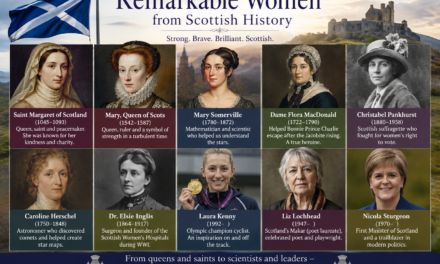
Mary Queen of Scots (1542–1587) — The Iconic Tragic Monarch
What She Did
Mary Stuart lived a life full of:
- Political drama
- International intrigue
- Arguments with England
- Emotional chaos
- Royal marriages (plural)
- Eventually losing her head (literally, not metaphorically)
Impact on the World Today
Mary remains:
- A symbol of Scotland’s royal past
- A global cultural icon
- An influence on modern monarchy narratives
Hollywood will never stop making films about her.
THE EXPLORERS WHO WENT EVERYWHERE (AND SOMETIMES GOT LOST)
Scots were everywhere during the age of exploration, often turning up in unexpected places like:
- Canada
- Antarctica
- Africa
- The Pacific
- Asia
David Livingstone (1813–1873) — “Dr Livingstone, I Presume?”
What He Did
Livingstone explored Africa, mapping huge areas and documenting African cultures.
He campaigned against the slave trade and became one of the most famous Scots in history.
Impact on the World Today
Livingstone helped:
- End the East African slave trade
- Advance global geography
- Build intercultural understanding
- Spread scientific and humanitarian work
He’s still widely respected internationally.
John Napier (1550–1617) — The Inventor of Logarithms
What He Did
Napier invented:
- Logarithms
- Napier’s Bones (an early calculator)
Impact on the World Today
His work allows:
- Engineering
- Astronomy
- Physics
- Computer science
- Navigation
Without Napier, maths would still be stuck in the Dark Ages.
THE SCOTS WHO SHAPED MODERN CULTURE
Scotland’s influence didn’t stop with science and exploration — it continues through modern culture.
Andrew Carnegie (1835–1919) — The Philanthropist Who Built Libraries Everywhere
What He Did
Carnegie became the richest man in the world (via steel), then gave away almost all his money — £8 billion in today’s value.
He built over 2,500 libraries.
Impact on the World Today
Carnegie shaped:
- Free public libraries
- Education
- Global philanthropy
- Cultural access
If you’ve ever borrowed a library book, thank Carnegie.
J. M. Barrie (1860–1937) — Creator of Peter Pan
What He Did
Barrie wrote Peter Pan, giving the world:
- Neverland
- Tinkerbell
- Captain Hook
- The concept of never growing up
Impact on the World Today
Peter Pan is:
- One of the most adapted stories ever
- A cornerstone of children’s literature
- A cultural phenomenon
- The inspiration for countless films, plays, books, and theme parks
Not bad for a lad from Kirriemuir.
Arthur Conan Doyle (1859–1930) — Father of Sherlock Holmes
What He Did
Doyle wrote the Sherlock Holmes stories.
Impact on the World Today
He created:
- The modern detective genre
- Forensic investigation concepts
- The world’s most famous fictional detective
Sherlock is now a global icon.
MODERN SCOTS WHO CONTINUE THE LEGACY
Scotland’s influence didn’t end in history. Modern Scots also shape the world.
Sir Ian Wilmut — Creator of Dolly the Sheep
He cloned the first mammal from an adult cell.
Impact:
- The foundation of modern genetic science
- Advances in stem cell research
- Medical and ethical revolutions
Gordon Brown — Economist & Former UK PM
Shaped global financial policies during the 2008 crisis.
Impact:
- International banking reforms
- Modern global economic coordination
Annie Lennox — Music Icon & Activist
Impact:
- One of the most influential musicians of the 20th century
- Major HIV/AIDS activist
- Global cultural influence
WHY SCOTS HAVE SUCH GLOBAL INFLUENCE
“How did one small country produce so many world-changing people?”
Here are the key reasons:
. The Scottish Education System
Scotland had free public schooling centuries before most countries.
The Scottish Enlightenment
An explosion of thinkers in the 18th century made Scotland the “brainbox of Europe.”
The Diaspora
Millions of Scots moved abroad, taking skills and ideas with them.
Cultural Attitudes
Scots love:
- Inventing
- Arguing
- Questioning authority
- Solving practical problems
These traits build geniuses.
CONCLUSION — WHY NOTABLE SCOTS STILL SHAPE THE WORLD TODAY
Let’s look at how Scots affect your everyday life:
- Every phone call (Bell)
- Every TV show or Netflix binge (Baird)
- Every electrical device (Maxwell)
- Every antibiotic (Fleming)
- Modern economics (Adam Smith)
- Libraries (Carnegie)
- Modern democracy (influenced by Scottish thinkers)
- Roads and bridges (Telford)
- Even fantasy and detective stories
Scotland has punched far, far above its weight in global influence.