“The Scottish question” usually refers to the debate over Scotland’s constitutional future: who should govern Scotland, how much power it should have, and whether it should become an independent country.
It is a question rooted in Scotland’s history, national identity, political institutions and relationship with the rest of the United Kingdom. It has become particularly prominent since the Scottish Parliament was established in 1999, the independence referendum in 2014, and the UK’s departure from the European Union.
1. How did the Scottish question begin?


6
The modern Scottish question has several historical roots.
- 1707 — The Acts of Union. The Kingdoms of Scotland and England joined to form the Kingdom of Great Britain. Scotland’s separate Parliament at Edinburgh was dissolved, while Scotland retained important institutions of its own, including its legal system, education system and established church.
- The 19th and 20th centuries — Home Rule and nationalism. Campaigners increasingly argued that Scotland needed its own legislature to address its distinctive political, economic and social circumstances.
- 1979 — The first devolution referendum. A majority of those who voted supported a Scottish Assembly, but the result failed to meet an additional statutory threshold, so devolution did not proceed.
- 1997–1999 — Devolution. Another referendum produced a strong endorsement of a Scottish Parliament, which opened in 1999. Scotland gained substantial powers over domestic affairs.
- 2014 — The independence referendum. Scotland voted to remain in the United Kingdom: 55.3% voted No and 44.7% voted Yes.
These events established the central tension: Scotland has a distinct national identity and substantial self-government, but it remains part of a sovereign United Kingdom.
2. What are the main positions today?

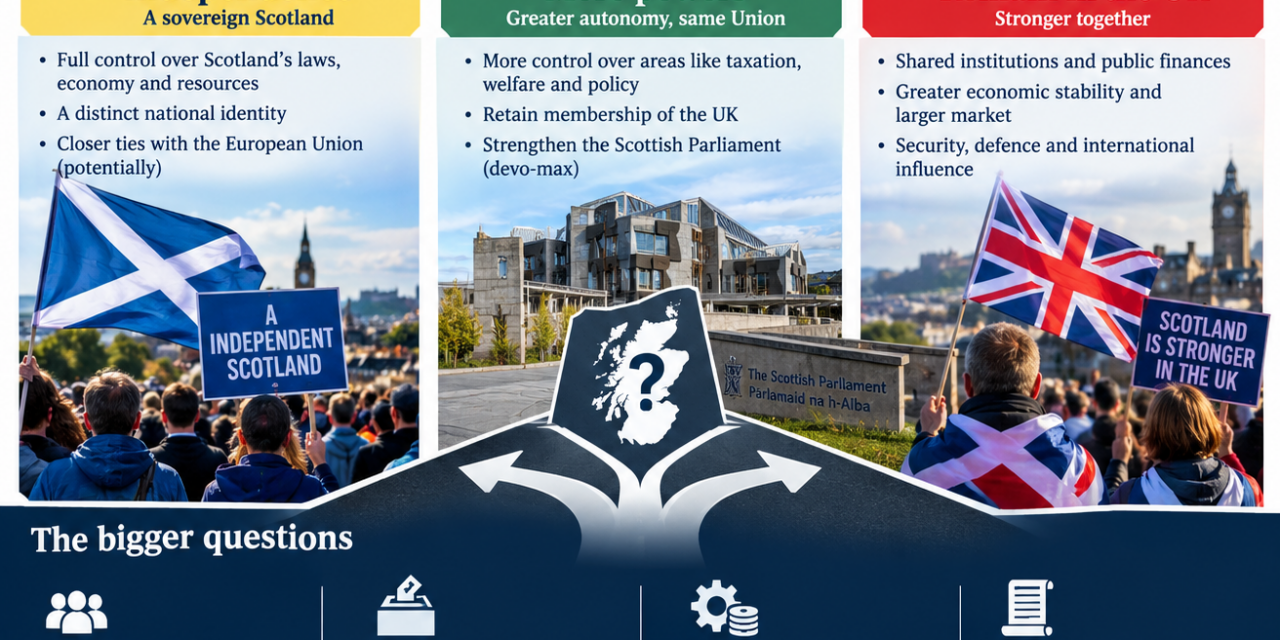
A. Scottish independence
Supporters, particularly the Scottish National Party (SNP) and some Scottish Greens, argue that Scotland should become a sovereign state.
Their main arguments include:
- Scotland should make its own political and economic decisions.
- Scottish voters should be able to choose policies that reflect their preferences.
- Independence could allow Scotland to pursue closer relations with the European Union.

B. Remaining in the United Kingdom
Unionists, including Scottish Labour, the Scottish Conservatives and the Scottish Liberal Democrats, support maintaining the Union, although they differ on how it should operate.
Their main arguments include:
- Scotland benefits from shared UK institutions and public finances.
- Remaining together provides economic stability and a larger common market.
- Separation could create uncertainty over currency, trade, defence and pensions.

C. More powers without independence
Others favour greater Scottish autonomy while retaining the Union. This is often described as devolution or devo-max, although the latter can mean different things.
Possible reforms include giving Scotland more control over taxation, welfare or other domestic policies while keeping the UK-wide state.
These positions reflect the continuing constitutional debate rather than three equally defined political programmes.
Institute for Government
+1
3. What powers does Scotland already have?
The Scottish Parliament at Holyrood has authority over many domestic matters, including:
- Health and the NHS in Scotland
- Education
- Scottish law and courts
- Much of local government
- Certain taxes, transport and environmental policies
The UK Parliament at Westminster retains responsibility for reserved matters such as defence, foreign affairs, immigration and the constitution of the Union. The precise division of powers is set out in the Scotland Act 1998 and subsequent legislation.
Institute for Government
+1
4. Why is another independence referendum controversial?
In November 2022, the UK Supreme Court ruled unanimously that the Scottish Parliament could not legislate for an independence referendum on its own, because the issue relates to matters reserved to Westminster. A referendum would therefore require an appropriate legal route, such as the UK Parliament agreeing to transfer the necessary power.
GOV.UK
+1
The disagreement is consequently about more than whether independence is desirable. It also concerns democratic mandates, parliamentary sovereignty and whether Scotland should be able to determine its constitutional future without Westminster’s agreement.
5. Why does the Scottish question matter?
At its heart, the Scottish question raises three fundamental issues:
- National identity: Can someone be Scottish and British, or should Scotland’s distinct national identity be expressed through an independent state?
- Democracy: Should decisions affecting Scotland be made primarily by Scottish voters and their representatives, or through shared UK institutions?
- Practical consequences: Would independence improve Scotland’s economy, public services and international position, or would the costs and uncertainties outweigh the benefits?
There is no universally accepted answer. The debate involves competing interpretations of history, different political priorities and uncertainty about the consequences of constitutional change.
One important distinction is that the Scottish question is not simply the question of independence. It also concerns the nature of the Union, the distribution of political power and the relationship between Scotland and the rest of the UK.