Women played an enormous role in making Scotland what it is today—although for a long time, history books gave them far less credit than they deserved.
If we tell Scotland’s story properly, women are not a side chapter. They are right in the middle of it.
Women and the making of Scotland
Women helped shape Scotland in many different ways:
- Queens and rulers influenced Scotland’s politics, religion and relationships with other countries.
- Women on farms and in crofting communities kept families, animals and communities going, often while men were away working or fighting.
- Women in industry worked in mills, factories, mines and fishing communities, helping Scotland become an industrial nation.
- Women in education became teachers and educational reformers, spreading learning throughout Scottish communities.
- Women in medicine and science broke through barriers and changed how people understood health and the world.
- Women in politics fought for the right to vote and later helped shape modern Scottish government.
- Writers, artists and musicians helped create Scotland’s cultural identity.
- Ordinary women—mothers, workers, activists, nurses, shopkeepers and community leaders—kept Scottish towns and villages functioning through enormous changes.
The powerful women of Scotland
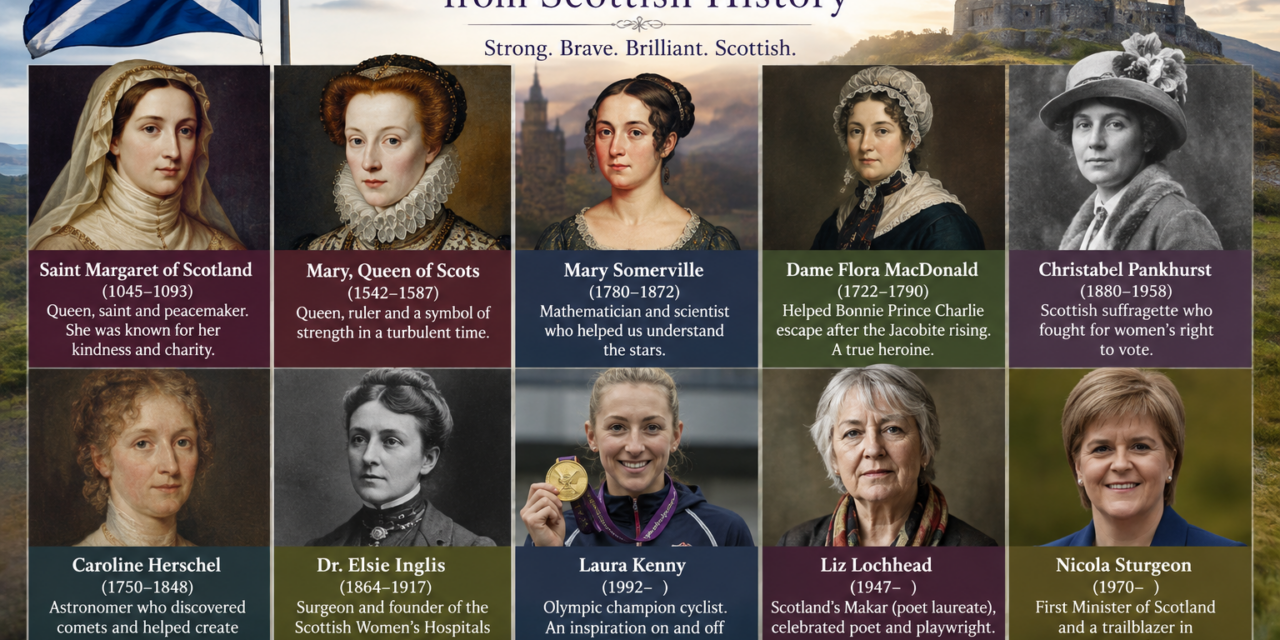
One of the most famous is Mary, Queen of Scots.
Mary’s life was incredibly dramatic. She became Queen of Scotland when she was only a baby, spent much of her childhood in France, returned to Scotland as a young woman and became caught up in political and religious struggles.
Her story shows that women could sit at the very centre of Scottish politics—but it also shows how dangerous that position could be.
Another important woman was Margaret of Norway, whose brief claim to the Scottish throne became part of the political crisis that eventually led to the Wars of Independence.
Women during the Wars of Independence
When we think about Scottish independence, we naturally think of figures such as Robert the Bruce and William Wallace.
But women were involved too.
Women managed estates, protected family interests, carried information, dealt with finances and sometimes became prisoners or political bargaining pieces.
A particularly fascinating example is Isabella MacDuff.
She supported Robert the Bruce’s claim to the Scottish crown and famously participated in his coronation at Scone in 1306.
For doing so, she was captured by the English and imprisoned.
Her story is a reminder that the struggle for Scotland was not simply a story of men carrying swords. Women also took political risks—and sometimes paid an enormous price for them.
The women who built everyday Scotland
This is perhaps the most important part of the story.
Most women in Scottish history were not queens or famous warriors.
They were ordinary women.
They worked on farms, raised children, spun wool, made clothing, prepared food, cared for elderly relatives and helped maintain communities.
In the Highlands and Islands, women played crucial roles in crofting and household economies. In fishing communities, women often processed fish, repaired nets, managed household finances and sold goods while men were at sea.
During the Industrial Revolution, thousands of Scottish women worked in textile mills.
In places such as Paisley, Dundee and Glasgow, women became an important part of Scotland’s industrial workforce.
So when we talk about Scotland becoming an industrial country, we should remember the women who stood beside the machines as well as the men who designed and operated them.
Women and education
Education is another area where Scottish women made a huge difference.
Scotland developed a reputation for education, but that achievement depended heavily on women.
Women became teachers in schools across the country, particularly during the nineteenth and twentieth centuries.
One remarkable figure was Mary Somerville.
Born in Jedburgh in 1780, Somerville became a celebrated mathematician, astronomer and scientific writer.
Her achievements were remarkable because women faced major restrictions on education and professional opportunities during her lifetime.
Another extraordinary Scottish woman was Elsie Inglis.
She became a doctor at a time when medicine was overwhelmingly dominated by men. During the First World War, she helped establish the Scottish Women’s Hospitals, which sent medical teams overseas to treat wounded soldiers and civilians.
Her story connects Scottish women with both the history of medicine and the international role Scotland played in the world.
Women changing Scottish politics
Women also transformed Scottish politics.
The campaign for women’s voting rights was a major part of Britain’s political history, and Scottish women were deeply involved.
Women organised meetings, marched, campaigned, wrote newspapers and challenged political leaders.
The movement eventually helped lead to women gaining the vote.
But winning the vote was only the beginning.
Scottish women later entered local councils, Parliament and public life in increasing numbers.
Today, women play leading roles across Scottish politics, business, education, science and culture.
Women and healthcare
Women have also been fundamental to Scotland’s healthcare system.
Nurses, doctors, midwives, researchers and carers have helped transform Scottish health.
Florence Nightingale is often remembered as an English figure, but Scotland was important to her story—she was born in Florence to a wealthy British family with strong Scottish connections and spent important periods in Scotland.
And Scottish women themselves made major contributions to nursing and medicine, including Elsie Inglis.
Their work helped move healthcare away from poorly organised charitable care towards more professional systems.
Women who shaped Scottish culture
Scotland’s identity has also been shaped by female writers and artists.
Nan Shepherd wrote beautifully about the Cairngorms and the relationship between people and landscape.
Muriel Spark became one of Scotland’s best-known twentieth-century writers.
And Liz Lochhead became Scotland’s second Makar, helping bring Scottish poetry and language to new audiences.
Women have therefore helped Scotland tell its own story—not just through politics but through poetry, novels, theatre, art and music.
Women and Scotland’s influence on the world
This is where the story gets really interesting for Bairns of Tamson.
Scottish women didn’t just help build Scotland.
They also helped carry Scottish ideas around the world.
Women travelled as teachers, missionaries, nurses, doctors, writers, settlers and researchers.
They helped establish schools and hospitals, contributed to scientific research and became part of communities across North America, Africa, Asia, Australia and elsewhere.
That means the story of Scottish influence around the world shouldn’t simply be:
“Here are some famous Scottish men who travelled abroad.”
It should be:
“Here are the Scottish men AND women whose ideas, work and lives helped shape the wider world.”
And what about the millions of women whose names we don’t know?
This may actually be the greatest story of all.
Imagine a Scottish woman in 1750.
Perhaps she never became famous.
Perhaps she never appeared in a history book.
But she might have:
grown food → raised children → looked after elderly relatives → worked for wages → made clothes → supported her community → taught children → survived wars and disease → and passed Scottish traditions to the next generation.
Multiply that woman by millions across hundreds of years.
Suddenly, you can see something important:
Scotland wasn’t built only by kings, soldiers, politicians and famous inventors.
It was built by ordinary people.
And women were half of those people.
The big lesson
So, what role did women play in the making of Scotland?
They helped make Scotland in virtually every possible way.
They ruled it.
They defended it.
They worked its farms and factories.
They educated its children.
They cared for its sick.
They fought for political rights.
They wrote its stories.
They preserved its traditions.
They challenged injustice.
They travelled around the world.
And they raised the generations that came after them.
Perhaps the best way to explain it to the children visiting Bairns of Tamson is this:
You cannot tell the story of Scotland without telling the story of Scottish women.
Because Scotland wasn’t made by a handful of famous people.
Scotland was made by its bairns—women and men, famous and forgotten, from every corner of the country.