How Scotland Helped Change the Way the World Learns
When we think about Scotland, we might picture magnificent castles, misty mountains, bagpipes, tartan, haggis and football. But Scotland has exported something rather more powerful than a good tune on the bagpipes: ideas.
For hundreds of years, Scots have travelled around the world as teachers, professors, missionaries, doctors, scientists, engineers and explorers. Wherever they went, many took an enormous respect for education with them.
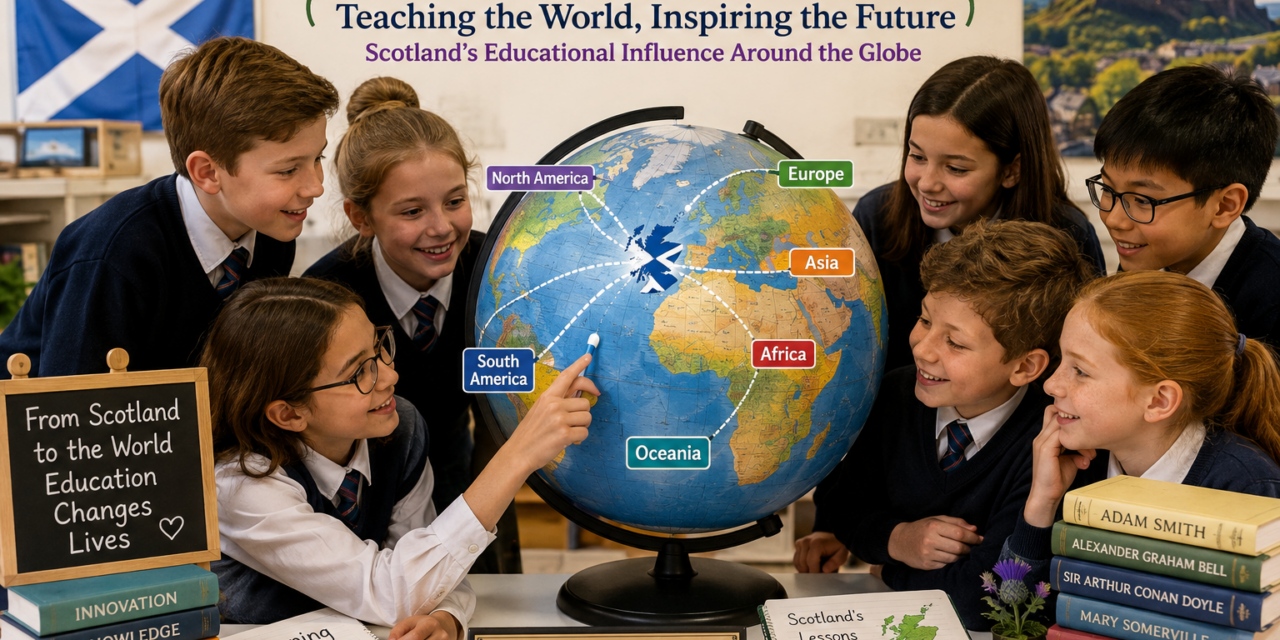
Scottish influence can be found in schools and universities across Europe, North America, Africa, Asia, Australia and New Zealand. Scottish thinkers helped develop new approaches to teaching, established schools and colleges, trained teachers and helped spread the idea that education should not be reserved only for the wealthy.
And that is a pretty important idea.
Because imagine a world where learning to read, write, count and understand the world around you was only available if your parents happened to be rich.
Not very fair, is it?
Scotland developed a remarkable educational tradition that helped challenge that idea. The story is complicated, and Scottish influence was sometimes connected to colonialism and missionary activity, but its educational legacy around the world is undeniable.
Scotland: The Little Country With a Big Educational Idea
One of the most interesting things about Scottish history is the country’s long-standing emphasis on education.
The roots go back centuries.
Following the Scottish Reformation in the sixteenth century, there was increasing enthusiasm for establishing schools and encouraging ordinary people to become literate. The famous First Book of Discipline, produced in 1560, called for a school in every parish.
That did not mean that Scotland suddenly became a land where every child had a shiny new school uniform and a packed lunch.
Far from it!
Education remained unequal, and poverty could prevent children from attending school. Rural communities could struggle to provide teachers and buildings, and girls and boys did not always receive the same opportunities.
Nevertheless, an important cultural idea was developing:
Education mattered.
By the eighteenth and nineteenth centuries, Scotland had developed a reputation for literacy and learning. Parish schools, private schools, universities and other educational institutions helped create a culture in which learning was highly valued.
This educational culture became one of Scotland’s great exports.
Scots travelled.
And when they travelled, they often carried their ideas about education with them.
The Scottish Enlightenment: When Scotland Became a Giant Classroom
The eighteenth century brought what became known as the Scottish Enlightenment.
Think of it as Scotland having one enormous intellectual conversation.
Philosophers, scientists, economists, historians and writers gathered in universities, clubs, libraries and coffee houses to debate some enormous questions.
How do people learn?
How should society be organised?
What makes a good government?
How does the human mind work?
How should children be educated?
What makes an economy successful?
And, perhaps most importantly:
How can human beings make the world better?
Among the famous figures associated with this intellectual movement were David Hume, Adam Smith, Adam Ferguson, Francis Hutcheson and William Robertson.
Their influence extended far beyond Scotland.
The Scottish Enlightenment helped establish a culture that valued observation, discussion, evidence and independent thinking.
That last bit is particularly important.
Education isn’t simply about memorising a mountain of facts until your brain feels like a stuffed schoolbag.
Good education should also teach people how to think.
That idea became one of Scotland’s most important gifts to the wider world.
Andrew Bell and the Monitorial System
One Scottish educator who had an enormous international impact was Andrew Bell, born in St Andrews in 1753.
Bell became a teacher and clergyman and spent several years in India.
While working at the Military Orphan Asylum in Madras, Bell observed a system in which older or more advanced pupils helped teach younger children.
He developed this idea into what became known as the Madras System, or monitorial system.
The basic idea was surprisingly simple.
Instead of one teacher trying to teach every child individually, older pupils, known as monitors, could help teach groups of younger children.
Think of it as:
Teacher → older pupils → younger pupils.
This allowed one teacher to work with a much larger number of children.
Bell returned to Britain and promoted the system.
It became influential in Britain and elsewhere, particularly during the nineteenth century.
Bell’s system was adopted and adapted in different places, including parts of Europe, North America, Africa and Asia.
Was it perfect?
Definitely not.
Modern educators would probably have a few things to say about having children do a lot of the teaching!
But Bell had identified a major problem: how do you provide education to large numbers of children when you don’t have enough teachers?
His answer became part of the history of mass education.
David Stow and the Training of Teachers
Another important Scottish educational pioneer was David Stow.
Born in Glasgow in 1793, Stow became particularly interested in improving education for working-class children.
He believed that teaching shouldn’t simply involve standing at the front of a classroom and shouting information at children.
Instead, teachers needed proper training.
In 1836, Stow established the Glasgow Normal School, designed to train teachers.
The term “normal school” might sound as though it was designed to teach people how to be normal.
Thankfully, that wasn’t the idea!
A normal school was a teacher-training institution.
Stow emphasised practical teaching and believed that children’s moral and social development mattered alongside academic learning.
His ideas influenced teacher training beyond Scotland.
And this brings us to something incredibly important:
If you want better schools, you need better-trained teachers.
That idea sounds obvious today.
But someone had to argue for it and develop systems to make it happen.
Scottish educators such as Stow helped do precisely that.
Scottish Universities: Education Without Borders
Scotland’s universities have also played a huge role in the international story of education.
The country’s ancient universities include:
- The University of St Andrews
- The University of Glasgow
- The University of Aberdeen
- The University of Edinburgh
These institutions became important centres of learning.
Students came to Scotland to study.
Scottish graduates travelled abroad.
Professors and academics accepted positions in other countries.
Books and ideas crossed borders.
And gradually, Scottish education became part of a much larger international network.
The University of Edinburgh, for example, became particularly famous for medicine, science and philosophy.
Glasgow became an important centre for commerce, science and engineering.
St Andrews developed an international reputation for scholarship.
Aberdeen became another important centre of education and research.
The result was a Scottish educational ecosystem that produced people who would go on to influence the world.
Scotland and North America
Perhaps nowhere is Scottish educational influence more visible than in North America.
Scottish immigrants and graduates became teachers, professors, ministers, doctors and university founders.
Scottish educational traditions influenced institutions in what became the United States and Canada.
One particularly interesting example is Princeton University.
The institution was strongly influenced by Scottish Presbyterian educational traditions, and a number of Scottish and Scottish-trained academics played significant roles in early American higher education.
Another famous institution, University of Pennsylvania, also developed connections with Scottish intellectual traditions.
And Scottish professors and graduates became influential across American colleges.
The connection went both ways.
American students and intellectuals travelled to Britain.
Scottish ideas travelled to America.
Books crossed the Atlantic.
Teachers crossed the Atlantic.
And eventually, an enormous intellectual conversation developed between Scotland and North America.
Scotland and Canada
Canada has particularly strong Scottish connections.
Scottish migration to Canada was substantial, especially during the eighteenth and nineteenth centuries.
Scots settled in places including Nova Scotia, Prince Edward Island, Ontario and Quebec.
They brought with them religious traditions, community organisations and educational ideas.
Scottish immigrants established schools, colleges and universities.
One of the most important examples is Dalhousie University in Halifax, Nova Scotia.
The university was founded in 1818 and was named after George Ramsay, the Earl of Dalhousie.
Scottish influence can also be found in the development of Queen’s University in Kingston, Ontario, which was founded with strong Scottish Presbyterian connections.
Scottish educational traditions therefore became part of the development of Canadian higher education.
And the story didn’t stop there.
Scottish-trained professionals became teachers, doctors, engineers, lawyers and academics throughout Canada.
Scotland and Africa
Now we come to a much bigger and more complicated chapter.
During the nineteenth century, Scottish missionaries and educators travelled to Africa.
Some went because of genuine religious and humanitarian convictions.
Others travelled as part of wider British imperial expansion.
That means the story needs to be told carefully.
Scottish educational influence in Africa brought schools, literacy programmes and teacher training to many communities.
But it also sometimes involved European cultural assumptions and missionary goals that could undermine or replace local traditions.
History is rarely as simple as:
“Scot arrives → builds school → everyone cheers.”
Real life is messier.
One of the most famous Scots associated with Africa was David Livingstone.
Livingstone was born in Blantyre in 1813.
He became a missionary, doctor and explorer.
He strongly opposed the slave trade and believed education and Christianity could contribute to African development.
His legacy is complicated because he was also part of the wider missionary and imperial world of nineteenth-century Britain.
Nevertheless, his journeys helped make Europeans more aware of parts of Africa that were little known in Britain.
Other Scottish missionaries and educators established schools and educational institutions across different parts of Africa.
In some places, schools eventually became important centres for the development of African intellectual and political leadership.
Education and the African Elite
One of the most interesting long-term effects of missionary and colonial education was the creation of educated African communities.
People who attended mission schools could become:
- Teachers
- Clerks
- Lawyers
- Doctors
- Journalists
- Ministers
- Politicians
- Writers
- Activists
Some later used their education to challenge colonial rule.
This is one of history’s fascinating twists.
Education introduced by colonial institutions could eventually provide people with the tools to criticise colonialism itself.
Literacy allowed people to read political ideas.
Education enabled people to organise.
Universities created intellectual communities.
Newspapers spread ideas.
So schools could become much more than places where children learned arithmetic and spelling.
They could become places where people learned how to imagine a different future.
Scotland and India
India has perhaps one of the strongest connections with Scottish education outside the United Kingdom.
Scottish missionaries, teachers, doctors and administrators travelled to India during the eighteenth and nineteenth centuries.
Scottish institutions became involved in education in places such as Calcutta, Bombay, Madras and other parts of India.
The Scottish Church College in Kolkata is one particularly notable example.
Founded in 1830, it grew from the work of Scottish missionary Alexander Duff.
Duff believed strongly in education.
He also believed that English-language education could be used to spread Christian ideas.
That means his work needs to be understood within the colonial and missionary context of the period.
Yet the institution he helped establish became an important centre of higher education.
Many Indian students passed through institutions influenced by Scottish educational traditions.
Some went on to become prominent scholars, lawyers, politicians and public figures.
Alexander Duff: The Teacher Who Went to India
Alexander Duff was born in Perthshire in 1806.
He travelled to India as a missionary and became an important figure in education there.
Duff supported the idea of providing higher education through English.
His educational work contributed to the development of institutions that later became significant in Indian education.
However, there was a major tension.
Duff’s goal wasn’t simply to provide education.
He also wanted to spread Christianity.
This is an important part of the history.
Scottish educational influence cannot always be separated from missionary activity, imperial power and cultural change.
Nevertheless, Indian students and intellectuals did not simply passively accept everything they were taught.
They took ideas from Western education and combined them with their own traditions and experiences.
The result was an extraordinary intellectual exchange.
Scots and the Birth of Modern Universities Around the World
Scottish influence was especially strong in higher education.
The Scottish university tradition placed considerable importance on broad education.
A student might encounter philosophy, languages, science, mathematics, medicine, history and other subjects.
This helped create the idea of a university as a place where students didn’t simply train for one particular job.
They were also expected to develop their minds.
This tradition influenced universities across the world.
Scottish academics helped establish or develop universities in different countries.
Some institutions adopted aspects of Scottish teaching traditions.
Others hired Scottish professors.
Still others were founded by Scottish missionaries, migrants or administrators.
It became a kind of educational chain reaction.
Scotland educated people → those people travelled → they taught others → those people taught still more people.
And suddenly, Scottish educational ideas were travelling around the planet.
Scotland and Australia
Australia also has a fascinating Scottish educational connection.
Large numbers of Scots migrated to Australia during the nineteenth century.
They brought their religious traditions, community organisations and educational ideas with them.
Scottish Presbyterian communities established schools and supported educational institutions.
The University of Sydney, founded in 1850, developed in a colonial environment strongly influenced by British and Scottish intellectual traditions.
Scottish professors and graduates became involved in Australian education, medicine and science.
The Scottish influence was also strengthened through migration.
Families who had Scottish roots established communities, churches and schools.
Over time, Scottish educational traditions became part of the broader Australian educational landscape.
Scotland and New Zealand
New Zealand also received substantial Scottish immigration.
The city of Dunedin is perhaps the most obvious example.
Dunedin was founded by Scottish settlers and developed strong connections with Scottish Presbyterian culture.
Even its name reflects Scotland.
“Dunedin” comes from Dùn Èideann, the Scottish Gaelic name for Edinburgh.
The University of Otago, founded in 1869, became New Zealand’s first university.
Its development took place within a community heavily influenced by Scottish settlers and Presbyterian traditions.
Today, Dunedin remains one of the most recognisably Scottish-influenced cities outside Scotland.
So if you ever find yourself wandering around Dunedin and thinking, “This feels strangely familiar,” you’re not imagining it.
Scots and Education in the Caribbean
Scottish educational influence also reached the Caribbean.
Scottish missionaries, teachers and ministers travelled throughout the region.
Schools were established by churches and religious organisations.
Scottish migrants also became teachers and professionals.
However, this history must be understood alongside the brutal history of slavery and colonialism.
Education in the Caribbean was deeply affected by social class, race and colonial power.
After emancipation, education became increasingly important in efforts to expand opportunities for formerly enslaved communities.
Mission schools and other educational institutions sometimes played important roles in these developments.
Again, the story is complicated.
The same empire that created systems of exploitation also produced educational networks that later helped some people challenge those systems.
History can be full of contradictions.
The Scottish “Jock Tamson’s Bairns” Idea
There is a lovely Scottish expression that fits our story perfectly:
“We’re a’ Jock Tamson’s bairns.”
It basically means:
“We’re all equal. We’re all human beings.”
The expression has long been associated with the idea that people are fundamentally equal, regardless of their background.
Education can be connected to this idea.
If education is only available to wealthy people, society becomes divided.
But if children from different backgrounds have opportunities to learn, education can become a great leveller.
This doesn’t mean Scotland always achieved equality.
It certainly didn’t.
Scottish society had enormous inequalities.
Women were excluded from many educational opportunities for centuries.
Working-class children often had fewer opportunities than wealthy children.
And colonial education could be deeply unequal.
But the ideal of education as something that should be widely available became increasingly powerful.
That idea has travelled a long way.
Women and Scottish Education
We also need to talk about women.
For much of history, women were denied the same educational opportunities as men.
Scotland was no exception.
But Scottish women eventually became important figures in education.
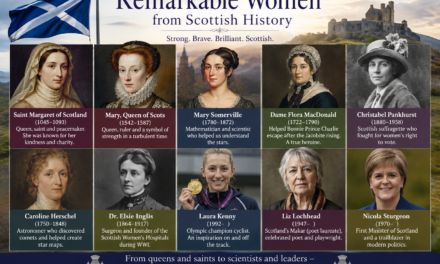
One fascinating example is Mary Somerville.
Born in Jedburgh in 1780, Somerville became an important mathematician, scientist and writer.
At a time when women faced significant barriers to scientific education, she pursued knowledge largely through self-education.
She became one of Britain’s most respected scientific writers.
Her achievements demonstrate something important:
Talent isn’t limited by gender. Opportunities often are.
As educational opportunities expanded, Scottish women became increasingly involved in teaching, medicine, science, literature and university education.
Eventually, women became students and professors at Scottish universities.
And Scottish-educated women also travelled abroad, spreading their expertise around the world.
Scots and the Idea of the Educated Citizen
One of the most important Scottish educational traditions was the belief that education should help create an educated citizen.
That meant education wasn’t only about getting a job.
It was also about understanding society.
The ideal citizen should be able to:
- Read
- Write
- Think critically
- Understand history
- Discuss ideas
- Make informed decisions
- Participate in community life
This was especially important during the Scottish Enlightenment.
Think about what that means today.
When you learn how to check whether something you see online is true, you’re using critical thinking.
When you learn history and consider different perspectives, you’re developing informed judgement.
When you debate an issue at school, you’re practising citizenship.
And when you learn how to ask:
“Hang on… is that actually true?”
you’re doing something very Scottish indeed.
Scottish Teachers Around the World
Perhaps the most important Scottish educational export wasn’t a university or a particular teaching system.
It was teachers.
Teachers travelled everywhere.
A Scottish teacher might end up in:
- Canada
- Australia
- New Zealand
- India
- South Africa
- Jamaica
- Ghana
- the United States
- Europe
They taught children.
They trained other teachers.
They established schools.
They wrote textbooks.
They ran universities.
They helped develop professional organisations.
And sometimes their students went on to become teachers themselves.
That created a multiplier effect.
One teacher could influence hundreds of students.
Those students could influence thousands more.
And suddenly one person’s educational journey could affect generations.
The Scottish Influence on Science Education
Scottish education also helped spread enthusiasm for science.
Scotland produced a remarkable number of scientists and inventors.
Think about:
James Clerk Maxwell and electromagnetism.
James Watt and improvements to the steam engine.
Alexander Graham Bell and the telephone.
Alexander Fleming and penicillin.
John Logie Baird and television.
These people were not simply clever individuals working in isolation.
They emerged from a culture that placed enormous value on learning, experimentation and intellectual curiosity.
Scottish universities and schools helped create that environment.
And Scottish scientists often became educators themselves.
Their work influenced generations of students.
Scottish Medicine and Education
Medicine provides another excellent example.
Scottish universities became famous for medical education.
Edinburgh in particular became a major international centre for medicine.
Students travelled from across Europe, North America and other parts of the world to study medicine in Scotland.
Some returned home and established medical schools and hospitals.
Others became professors.
Still others introduced Scottish medical teaching methods to their own countries.
This created an international network of medical education.
So when we talk about Scottish influence on education, we shouldn’t imagine it as simply primary-school teachers.
Scottish influence reached:
schools → colleges → universities → professional education → medicine → science.
It was a whole educational ecosystem.
The Scottish Model and Colonialism
Now we need to tackle one of the more uncomfortable parts of the story.
Scottish educational influence around the world cannot be separated from the British Empire.
Many Scots travelled abroad because Britain had colonies.
Some were missionaries.
Some were administrators.
Some were soldiers.
Some were businessmen.
Some were teachers and doctors.
Education could be genuinely beneficial, but it could also be used to encourage European cultural values and colonial systems.
Local languages and traditions were sometimes pushed aside.
Education could favour certain groups over others.
Access to schools could be unequal.
So we shouldn’t tell the story as though Scottish educational influence was always wonderful and uncomplicated.
It wasn’t.
The honest story includes both achievements and problems.
This is actually a great lesson for young people.
History isn’t a superhero movie where everyone is either completely good or completely bad.
Real people can do good things while being part of systems that cause harm.
Understanding those contradictions helps us understand history properly.
Education as a Tool for Independence
Here’s where things get particularly interesting.
Education can help people challenge power.
Across the world, educated people became writers, journalists, lawyers, politicians and activists.
They learned about ideas such as democracy, liberty, equality and national self-determination.
Some began asking:
“If these ideas apply to Europeans, why shouldn’t they apply to us?”
Schools and universities therefore sometimes became centres of anti-colonial thought.
People who had received Western-style education could use those very ideas to challenge colonial rule.
This happened across Asia and Africa.
Education could therefore become a powerful tool for independence.
That is one of the great paradoxes of the history of education and empire.
Scots and the Spread of Literacy
Literacy might sound boring compared with castles and battles.
It isn’t.
Being able to read changes your world.
If you can read, you can access:
- Newspapers
- Books
- Scientific information
- Laws
- Political ideas
- Stories
- Religious texts
- Maps
- Instructions
- Other people’s experiences
Literacy gives people access to information without requiring someone else to explain everything to them.
Scottish educational traditions helped contribute to wider literacy campaigns in different parts of the world.
And once people become literate, they can teach others.
A parent can teach a child.
A child can eventually teach another child.
A teacher can train another teacher.
Knowledge spreads.
Scotland’s Educational Influence Today
So, does Scottish educational influence still matter?
Absolutely.
Modern Scotland continues to have internationally connected universities, researchers and educational institutions.
Scottish universities attract students from around the world.
Scottish academics conduct research internationally.
Scottish teachers, scientists and professionals work in countries across the globe.
And Scottish ideas continue to influence education.
But perhaps the biggest legacy is the belief that education should be about more than memorising information.
It should develop:
curiosity.
critical thinking.
creativity.
discussion.
independent thought.
community.
Those are ideas that remain incredibly valuable in the twenty-first century.
There is a huge lesson here.
You don’t need to be famous to influence the world.
A teacher might teach thirty children.
One of those children might become a scientist.
Another might become a doctor.
Another might become a writer.
Another might become a teacher.
And that teacher might teach another thirty children.
The chain continues.
This is why teachers have such extraordinary influence.
They don’t simply teach today’s children.
They help shape tomorrow’s adults.
That’s a pretty impressive job.
Scotland’s Greatest Educational Export
So what was Scotland’s greatest educational export?
Was it the monitorial system?
Was it teacher training?
Was it the universities?
Was it the Scottish Enlightenment?
Was it the thousands of teachers and professors who travelled around the world?
Perhaps it was all of these.
But underneath everything was a simple idea:
Learning matters.
Education can change an individual life.
It can change a family.
It can change a community.
And eventually, it can change an entire country.
From Edinburgh to the World
Scotland is a small country.
But its educational connections stretch across the globe.
From India to Canada.
From Africa to Australia.
From New Zealand to the Caribbean.
From America to Europe.
Scottish teachers, professors, scientists, missionaries and students became part of a worldwide educational network.
Some of their work was admirable.
Some was complicated.
Some was connected to colonialism.
Some had consequences that the people involved could never have predicted.
But the influence is clear.
Scottish education became part of the story of how modern education developed around the world.
And perhaps that brings us back to the old Scottish phrase:
We’re a’ Jock Tamson’s bairns.
Education works best when knowledge isn’t treated as something belonging only to a privileged few.
It works when children are encouraged to ask questions.
When teachers encourage curiosity.
When universities welcome ideas.
When people are given the opportunity to discover what they can do.
Scotland didn’t invent education.
Obviously not!
People were learning, teaching and sharing knowledge thousands of years before Scotland existed.
But Scotland developed a particularly powerful educational tradition.
And generations of Scots carried that tradition around the world.
The Big Scottish Education Journey
Let’s take one final trip around the map.
Scotland
Developed a strong culture of literacy, universities, parish education and intellectual debate.
India
Scottish missionaries and educators established and influenced schools and colleges, while Indian students adapted and developed ideas in their own ways.
Canada
Scottish migrants and educators contributed to schools, universities and professional education.
United States
Scottish intellectual traditions influenced colleges, universities and educational thought.
Africa
Scottish missionaries and educators established schools and teacher-training programmes, while education later became important in the development of African intellectual and political movements.
Australia
Scottish migrants, teachers and academics contributed to the development of schools, universities and professional education.
New Zealand
Scottish settlers and educators helped establish institutions and communities, particularly around Dunedin and the University of Otago.
Caribbean
Scottish missionaries and educators participated in educational developments within societies shaped by slavery, emancipation and colonialism.
And that’s only a selection.
The Scottish educational story is much bigger.
The Bairns of Tamson Lesson
Here at Bairns Of Tamson, there’s a particularly good lesson hiding inside all of this.
Scotland has never existed in isolation.
Scots travelled.
They met other people.
They exchanged ideas.
They sometimes got things spectacularly right.
Sometimes they got things spectacularly wrong.
And sometimes they did both at once.
But the most important part of the story is what happened when people shared knowledge.
That’s how humanity moves forward.
One person learns something.
They teach somebody else.
That person adds something new.
Another person improves it.
Someone else challenges it.
And eventually, an idea that started in one place can travel around the entire planet.
That’s education.
And that’s why the influence of Scots on education around the globe is such a fascinating story.
Quick-Fire Scottish Education Facts
Did you know?
Scotland has four ancient universities: St Andrews, Glasgow, Aberdeen and Edinburgh.
Andrew Bell, from St Andrews, developed the monitorial teaching system after observing educational practices in India.
David Stow was an important pioneer of teacher training in Glasgow.
🇮🇳 Alexander Duff played a major role in the development of English-language higher education in India through his missionary and educational work.
Dunedin in New Zealand takes its name from the Scottish Gaelic name for Edinburgh, Dùn Èideann.
Scottish universities became internationally famous for medicine, science, philosophy and other subjects.
Scottish teachers, missionaries, academics and professionals travelled throughout the British Empire and beyond.
The Scottish Enlightenment encouraged critical thinking, inquiry and debate.
Scottish educational traditions helped contribute to the wider development of literacy.
Scottish influence on education is therefore not just a Scottish story. It is part of a global story.
Final Thought
Next time you sit and open a book, use a computer to research something or ask a difficult question
Remember that you’re participating in a very old human tradition.
People have always wanted to know more.
Scotland became particularly famous for encouraging that curiosity.
And Scottish teachers, students, scientists and thinkers carried that educational spirit across oceans and continents.
The greatest lesson of all might be this:
Knowledge becomes more powerful when you share it.
From a small country in the northern part of Europe, educational ideas travelled around the world.
Not bad for a country famous for haggis, bagpipes and rainy weather.
And if you’re wondering whether the Scots invented homework…
We’re still investigating.
That one might be best left to the historians.