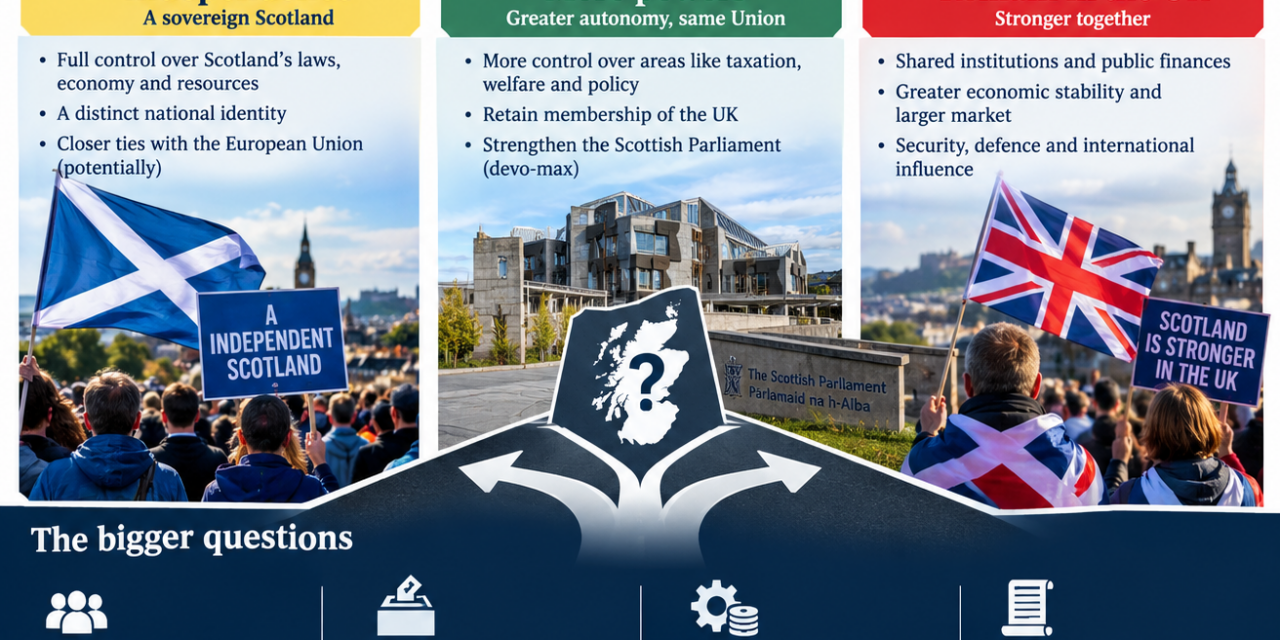
The Scottish Question concerns the appropriate distribution of political power and sovereignty between Scotland and the United Kingdom, including debates over devolution, nationalism, independence and the future of the Union.
Imagine the UK is a team made up of four countries:
- 🏴 Scotland
- 🏴 England
- 🏴 Wales
- 🇬🇧 Northern Ireland
They share some big things, such as the UK government, currency and defence.
So what’s the argument?
The Scottish independence question is basically:
Should Scotland continue being part of the UK, or should Scotland become its own independent country?
People who support independence say:
- Scotland should be able to make all its own important decisions.
- Scotland has its own parliament and a strong national identity.
- They believe Scotland could run its economy and public services better on its own.
People who support staying in the UK say:
- Being part of the UK gives Scotland economic and political advantages.
- The four countries can achieve more by working together.
- Becoming independent could create uncertainty about things like money, trade and government.
What happened in 2014?
Scotland actually held a vote on independence in 2014.
The question was essentially:
Should Scotland be an independent country?
The result was:
55% — No ❌
45% — Yes ✅
So Scotland remained part of the UK.
However, the argument didn’t disappear. Brexit made the issue even more complicated, because Scotland voted strongly to remain in the European Union while the UK as a whole voted to leave.
The Scottish question is the big debate about whether Scotland should remain part of the United Kingdom or become an independent country.
It helps to think of the “Scottish question” as a constitutional and political debate, rather than simply a question of independence.
What is the Scottish Question?
The Scottish Question refers to the long-running debate about Scotland’s constitutional status within the United Kingdom.
In simple terms, it asks:
How much political power should Scotland have over its own affairs, and should Scotland ultimately remain part of the UK at all?
There are therefore several possible answers, not just “independence” or “union”.
1. The Union
Scotland has been part of the United Kingdom since the Acts of Union of 1707, when the Scottish and English Parliaments were united.
Under the traditional Union settlement, major areas such as:
- defence
- foreign affairs
- taxation
- monetary policy
were primarily controlled at the UK level.
Scotland nevertheless retained important institutions of its own, particularly its legal system, education system and church.
2. Devolution
A major development came with the Scottish Parliament, established in 1999 following the 1997 referendum.
This is called devolution.
Devolution means that the UK Parliament remains legally sovereign, but it gives certain powers to the Scottish Parliament.
For example, the Scottish Parliament has significant responsibility for areas such as:
- health
- education
- justice
- transport
- some taxation
So Scotland is not an independent country, but it has considerably more self-government than it did before 1999.
3. Independence
The most dramatic answer to the Scottish Question is Scottish independence.
The argument is that Scotland should become a sovereign state and therefore have ultimate authority over its own laws, economy and international relations.
This was put directly to voters in the 2014 independence referendum.
The result was:
- 55% No — remain in the UK
- 45% Yes — become independent
Scotland therefore remained within the UK.
4. Why is the question still important?
The debate didn’t end in 2014.
One particularly important event was Brexit.
In the 2016 EU referendum:
- The UK as a whole voted to leave the EU.
- Scotland voted to remain in the EU.
This created a political argument about whether Scotland’s constitutional future should be reconsidered.
Supporters of independence argue that Scotland was taken out of the EU despite Scottish voters choosing to remain.
Unionists argue that the 2014 referendum already gave voters a decision on independence and that the UK should remain together.
The key concept: sovereignty
sovereignty is probably the most useful concept to understand.
Sovereignty = ultimate political authority.
The fundamental disagreement is therefore about where ultimate political authority over Scotland should lie:
UK sovereignty
→ Scotland remains part of the UK
→ Scottish Parliament has devolved powers
→ UK Parliament remains legally sovereign
Scottish sovereignty
→ Scotland becomes an independent state
→ Scottish institutions have ultimate authority
→ Scotland conducts its own foreign affairs and defence, etc.
Why political scientists care about it
The Scottish Question raises much bigger questions about:
Nationalism — What makes Scotland a nation, and should nations have their own states?
Federalism vs centralisation — Should political power be concentrated in Westminster or distributed among the UK’s nations and regions?
Constitutionalism — Who has the authority to change the UK’s constitutional arrangements?
Democracy — If Scotland votes for something different from the rest of the UK, how should that be handled?
Identity — Can someone simultaneously be Scottish and British, or do these identities conflict?
Don’t think of the Scottish Question simply as “Should Scotland be independent?”
A better way of putting it is:
The Scottish Question concerns the appropriate distribution of political power and sovereignty between Scotland and the United Kingdom, including debates over devolution, nationalism, independence and the future of the Union.